LABORATORY OF MOLECULAR CANCER GENETICS
Research

Laboratory of Molecular Cancer Genetics

Research

Research

How we investigate the laboratory's central questions

The Ciribilli laboratory investigates the molecular networks that shape breast, colon and melanoma progression. The group studies how the transcriptional repressor ETV7 creates chemoresistant and stem-like states, how shorter p53-family isoforms alter tumour behaviour, and how epithelial–mesenchymal transition and the microenvironment support angiogenesis and metastasis. Its work combines gene-expression analysis in patient material, mechanistic experiments in cancer cells, two- and three-dimensional models, molecular perturbation and translational biomarker studies to connect regulatory pathways with prognosis and treatment response.
01

ETV7-mediated stemness and chemoresistance

We define how ETV7 rewires interferon and stress-response networks to create breast-cancer states that survive chemotherapy and retain stem-like plasticity.

ETV7 is a transcriptional repressor whose elevated activity can reshape cancer-cell identity. The laboratory studies how ETV7 suppresses interferon-response and mitochondrial stress pathways, alters inflammatory signalling and promotes survival under chemotherapy.
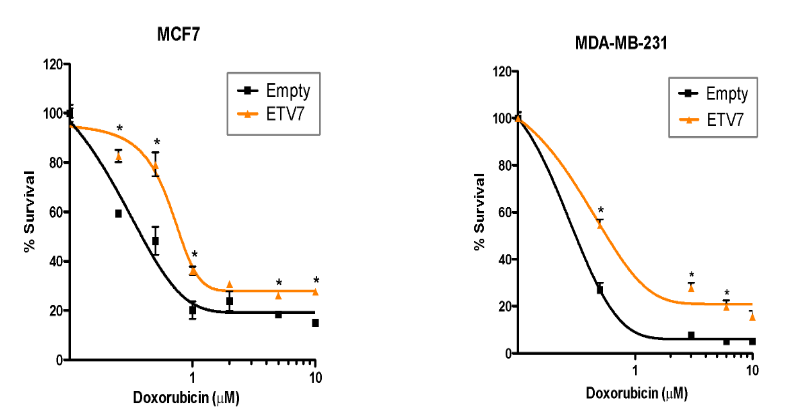
ETV7-dependent doxorubicin response in MCF7 and MDA-MB-231 breast-cancer cells. Official LMCG research image, University of Trento.
02

p53-family isoforms and cancer plasticity

We investigate how shorter p53 and p73 isoforms change localisation, transcriptional output and aggressive behaviour in melanoma and other cancers.

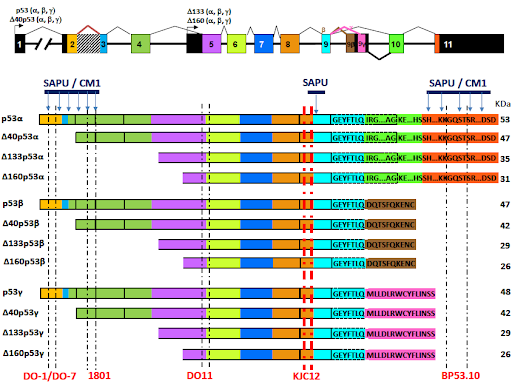
The TP53 family produces multiple protein isoforms with distinct domains and activities. The laboratory measures isoform expression and localisation and tests how altered ratios affect canonical p53-family responses.

Schematic map of p53 isoforms and antibody-recognition sites. Official LMCG research image, University of Trento.
03

EMT, microenvironment and metastatic progression

We study how MYC, inflammatory signalling and stromal cues coordinate epithelial–mesenchymal transition, angiogenesis, invasion and metastatic colonisation.

Metastasis is not produced by a single oncogene but by coordinated changes across cancer cells and their environment. The group investigates how MYC and other transcriptional networks alter secreted factors, extracellular signalling and angiogenic programmes.

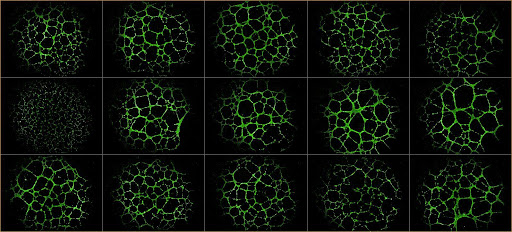
Fluorescence images from a three-dimensional cellular model. Official LMCG research image, University of Trento.
04

Patient gene signatures and precision oncology

We translate mechanistic findings into expression signatures that classify breast and colon cancers and may predict prognosis or treatment response.

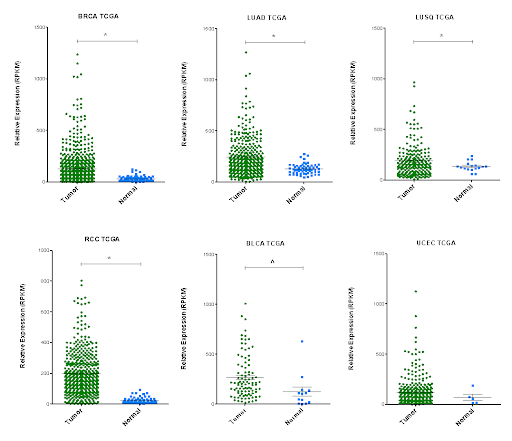
The laboratory analyses gene expression in biopsies from cancer patients alongside cell-line and model-system data. This design helps distinguish mechanisms that are experimentally tractable from associations that remain relevant in human tumours.

TCGA tumour-versus-normal gene-expression comparisons across cancer cohorts. Official LMCG research image, University of Trento.